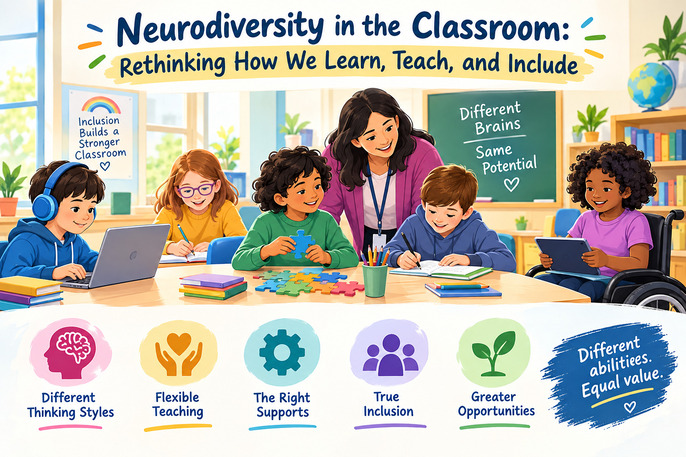
Every student enters a classroom with a different way of thinking, learning, communicating, and experiencing the world. Yet traditional education has often been designed around the idea that there is one “right” way to learn.
Neurodiversity invites us to rethink that idea.
The concept recognizes that differences in how people think and process information are a natural part of human diversity. Students with autism, ADHD, dyslexia, dyspraxia, and other neurological differences may learn and communicate in ways that differ from conventional classroom expectations. These differences should not automatically be viewed as limitations. With the right environment and support, students can participate, learn, and demonstrate their abilities in meaningful ways.
Creating a neurodiverse-friendly classroom is therefore not about lowering expectations. It is about removing unnecessary barriers to learning.
What Is Neurodiversity?
Neurodiversity refers to the natural variation in how human brains function and process information. The term is often used in discussions about autism, ADHD, dyslexia, and other neurological or developmental differences.
A neurodiverse classroom recognizes that students may differ in areas such as:
- Attention and concentration
- Reading and writing
- Sensory processing
- Communication
- Memory and information processing
- Social interaction
- Organization and planning
- Problem-solving and creativity
Not every student with the same diagnosis will have the same strengths or challenges. This is why inclusive education should focus on the individual rather than relying solely on a label.
Moving Beyond the “One-Size-Fits-All” Classroom
Traditional classrooms frequently depend on standardized teaching methods: listening to a lecture, taking notes, reading a textbook, completing written assignments, and taking timed tests.
These methods can work well for some students, but they may create unnecessary barriers for others.
For example, a student who understands a concept extremely well may struggle to demonstrate that understanding through a lengthy written assignment. Another student may know the answer but need additional processing time before responding.
Inclusive education asks an important question:
Are we measuring what a student knows, or are we measuring how well they can adapt to one particular way of demonstrating it?
The answer can influence everything from teaching strategies to assessment methods.
Creating More Inclusive Classrooms
A neurodiversity-friendly classroom can benefit everyone, not only neurodivergent students.
Teachers can introduce simple changes such as:
1. Offer Multiple Ways to Learn
Important concepts can be presented through a combination of:
- Visual materials
- Spoken explanations
- Demonstrations
- Written instructions
- Hands-on activities
- Videos and interactive resources
Providing different ways to access information gives students more opportunities to find approaches that work for them.
2. Make Instructions Clear and Predictable
Long or complicated instructions can become overwhelming.
Teachers can break larger tasks into smaller steps, use clear language, provide written instructions alongside verbal ones, and explain what students should expect during an activity.
Visual schedules, checklists, and examples can also help students understand what needs to be completed.
3. Recognize Different Communication Styles
Not every student communicates in the same way.
Some students may prefer speaking, while others may communicate more comfortably through writing, typing, visual tools, or assistive communication technologies.
Inclusive classrooms should create opportunities for students to express their knowledge without unnecessarily restricting them to one communication method.
4. Consider Sensory Needs
Classrooms can contain bright lights, loud conversations, crowded spaces, strong smells, or constant movement. For some students, these sensory experiences can make concentration difficult.
Where possible, schools can provide quieter spaces, allow appropriate sensory tools, reduce unnecessary classroom noise, and give students opportunities for movement or breaks.
These adjustments are not special treatment. They can simply create conditions in which students are better able to participate.
Rethinking Assessment
Examinations and assignments are important tools for measuring learning, but they are not the only possible ways to demonstrate knowledge.
Depending on the learning objective, teachers may consider different approaches, such