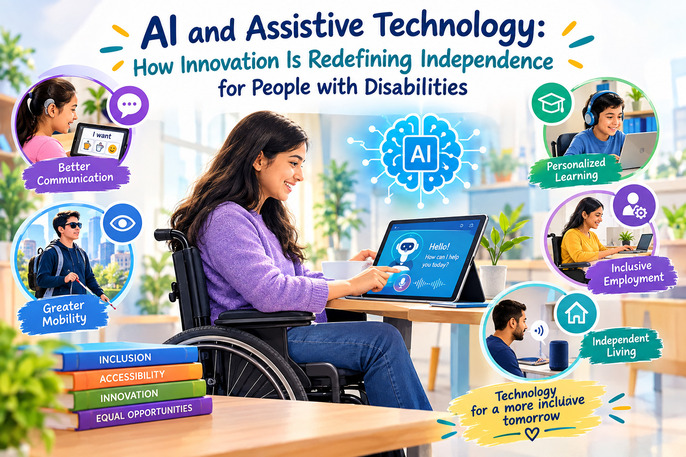
Technology has always had the power to change lives. But for people with disabilities, the right technology can do something even more meaningful: it can remove barriers, expand choices, and create new opportunities for independence.
Today, artificial intelligence (AI) and assistive technology are transforming how people communicate, learn, work, travel, access information, and participate in everyday life. From speech recognition and smart navigation to screen readers and AI-powered visual assistance, innovation is opening doors that were previously difficult or impossible to access.
The goal is not to make everyone interact with technology in the same way. It is to give people more ways to interact with the world on their own terms.
What Is Assistive Technology?
Assistive technology refers to products, devices, software, and systems that help people perform tasks or participate more independently.
These technologies can range from relatively simple tools to sophisticated AI-powered systems.
Examples include:
- Screen readers that convert digital text into speech
- Hearing and communication technologies
- Speech-to-text and text-to-speech tools
- Alternative and augmentative communication systems
- Wheelchairs and mobility equipment
- Accessible keyboards and input devices
- Magnification and visual-support tools
- Smart-home technologies
- Navigation and orientation tools
The technology itself is important, but its real value lies in what it enables a person to do.
How AI Is Changing Assistive Technology
Traditional assistive technologies often perform a specific function. AI can make these systems more adaptive and responsive.
AI systems can process language, recognize patterns, interpret images, generate text, and respond to natural-language instructions. When these capabilities are integrated into accessibility tools, they can provide more personalized assistance.
For example, AI may help a person:
- Understand information presented in an image
- Convert speech into written text
- Generate or simplify written content
- Navigate digital interfaces using natural language
- Receive contextual descriptions of surroundings
- Communicate using alternative input methods
- Organize information and complete everyday tasks
These applications are developing rapidly, and their usefulness depends on factors such as accuracy, accessibility, privacy, cost, and individual needs.
AI-Powered Visual Assistance
For people who are blind or have low vision, accessing visual information can present significant challenges.
AI-powered tools can analyze images and provide descriptions of objects, environments, documents, or text. Optical character recognition can also help convert printed material into digital or spoken information.
Imagine receiving a menu at a restaurant and being able to use a smartphone to identify and read the menu items. Or receiving a document and using accessible technology to understand its contents without relying entirely on another person.
These capabilities can provide greater flexibility in everyday situations.
However, AI-generated descriptions are not always accurate. Important decisions should not depend solely on an AI system when accuracy is critical.
Communication Becomes More Accessible
Communication technology is another area where AI can make a meaningful difference.
Speech-to-text tools can turn spoken language into written communication, while text-to-speech technology can convert written responses into spoken language.
For people who use augmentative and alternative communication (AAC), digital systems can provide additional ways to express thoughts, needs, and preferences.
AI may also help personalize communication systems by making predictions or adapting to frequently used words and phrases.
The objective is not simply faster communication. It is greater opportunity for people to express themselves and participate in conversations, education, employment, and social life.
Supporting People with Hearing Disabilities
AI and digital technologies are also creating new possibilities for people who are deaf or hard of hearing.
Automatic captioning and transcription can make spoken content more accessible in classrooms, workplaces, meetings, videos, and online events.
Real-time transcription can be especially useful when multiple people are speaking or when information needs to be understood quickly.
At the same time, accessibility should not depend entirely on automated tools. Human-generated captions, interpreters, accessible event planning, and clear communication practices remain important.
Technology works best when it forms part of a broader accessibility strategy.
Smart Homes and Greater Independence
Smart-home technology can help people control aspects of their environment using smartphones, switches, voice commands, sensors, or other accessible interfaces.
Depending on an individual’s needs, smart technology may help control:
- Lights
- Doors
- Temperature
- Appliances
- Security systems
- Entertainment devices
- Household routines
For someone with limited mobility, being able to control their environment without physically reaching a switch or appliance can make everyday activities easier.
The broader idea is important: technology can give people more control over their surroundings.
AI in Education
Education is another area where assistive technology can make a difference.
Students may use tools such as text-to-speech, speech-to-text, digital note-taking, captions, reading assistance, and organizational applications.
AI can potentially support personalized learning by helping students access information in different formats or by assisting with tasks such as summarizing complex material.
But technology should complement educators rather than replace them.
Teachers remain essential for understanding students’ individual needs, providing encouragement, evaluating learning, and creating an inclusive classroom environment.
Assistive Technology in the Workplace
Technology can also influence employment opportunities.
Accessible digital tools can help employees communicate, organize information, participate in meetings, access documents, and complete job-related tasks.
Examples include:
- Screen-reading software
- Voice-control systems
- Captioning
- Accessible collaboration platforms
- Alternative input devices
- AI-powered productivity tools
- Digital scheduling and organization tools
Employers can support inclusion by ensuring that workplace technology is accessible from the beginning rather than treating accessibility as an afterthought.
Technology Can Reduce Dependence Without Removing Human Connection
Independence does not mean doing everything alone.
This is an important distinction.
Assistive technology can reduce the need for assistance with certain tasks, but human relationships remain essential. Family members, teachers, colleagues, support professionals, friends, and communities continue to play important roles.
The purpose of technology should be to expand choice and control, not to isolate people from others.
A person may use technology to navigate independently while still enjoying companionship. They may use communication technology while continuing to build relationships. They may use AI to access information while relying on teachers or professionals for guidance.
Independence and connection can exist together.
The Challenges Behind the Innovation
The rapid development of AI and assistive technology also raises important questions.
Accessibility
A technology cannot be considered truly inclusive if people with disabilities cannot use the interface itself.
Developers need to consider accessibility throughout the design and development process.
Affordability
Advanced technology can be expensive. If innovative tools are available only to people who can afford them, their social impact will remain limited.
Privacy
Assistive technologies may process highly personal information, including voice recordings, images, location data, health-related information, or communication content.
Privacy and data protection therefore need to be considered carefully.
Accuracy and Reliability
AI can make mistakes.
An incorrect image description, transcription, navigation instruction, or generated response could have serious consequences in some situations.
Users should understand the limitations of AI systems, particularly when safety or important decisions are involved.
Digital Skills
Having access to technology is only one part of inclusion. People also need appropriate training, support, and confidence to use it effectively.
Designing Technology With People, Not Just For People
One of the most important principles of inclusive innovation is involving people with disabilities in the design process.
Developers and organizations can learn things from lived experience that may not be obvious from technical specifications alone.
User testing, accessibility research, feedback, and co-design can help identify barriers before products reach a wider audience.
A simple question can change the development process:
Who is missing from the design conversation?
When people with different abilities participate in creating technology, products can become more useful, practical, and inclusive.
The Future of AI and Assistive Technology
The future could bring even more personalized assistive systems.
AI may increasingly be integrated into smartphones, wearable devices, smart homes, educational platforms, workplace software, and mobility solutions.
We may see technology that adapts more naturally to individual preferences and provides assistance across different environments.
But technological progress alone will not create inclusion.
Accessible infrastructure, affordable products, responsible data practices, inclusive policies, education, and changing attitudes are equally important.
The most meaningful innovations will not simply be the ones with the most advanced features. They will be the ones that help people exercise greater choice, participate more fully, and live according to their own goals.
Conclusion
AI and assistive technology are changing the possibilities of accessibility.
From communication and education to employment, mobility, and independent living, technology can help remove barriers that have historically limited participation.
But inclusion should never be measured only by what technology can do.
It should also be measured by who can access it, who can afford it, who helped design it, how safely it works, and whether it genuinely gives people greater choice and control.
The future of assistive technology is therefore not simply about smarter machines.
It is about creating a world in which technology adapts to human diversity—and where people with disabilities have more opportunities to learn, work, communicate, participate, and live independently.