Technology has always had the power to change lives, but today, artificial intelligence (AI) is taking that potential even further. For people with disabilities and diverse abilities, AI is opening new possibilities for communication, education, mobility, employment, and independent living.
Accessibility is no longer only about making existing products easier to use. With AI, technology can increasingly adapt to the individual, understand different ways of interacting, and help remove barriers that have traditionally limited participation.
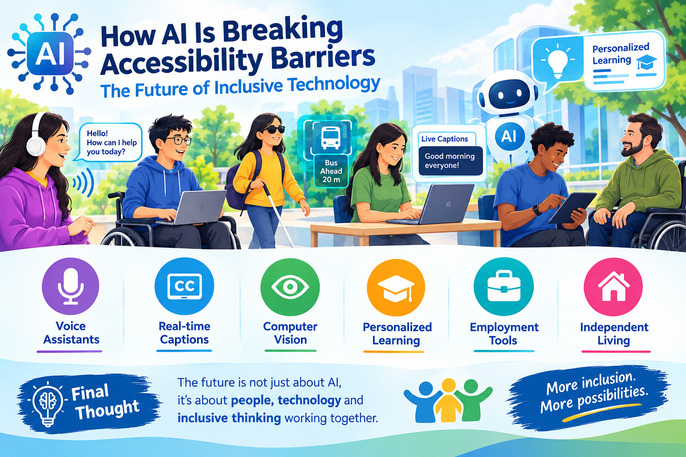
From voice assistants and real-time captions to computer vision and personalized learning tools, AI is helping create a world where technology can work for more people.
What Does Inclusive Technology Mean?
Inclusive technology refers to digital tools, devices, software, and services designed so that people with different abilities can use and benefit from them.
Traditional accessibility often focuses on providing specific features—for example, screen readers for people with visual disabilities or captions for people who are deaf or hard of hearing.
AI introduces another dimension: adaptability.
Instead of expecting everyone to interact with technology in exactly the same way, AI can help technology respond to individual needs and preferences.
For example, an AI-powered system may convert speech into text, describe visual information, translate languages, simplify complex information, or recognize alternative forms of interaction.
How AI Is Breaking Accessibility Barriers
1. Making Communication More Accessible
Communication can be challenging for people with speech, hearing, or other communication differences.
AI-powered speech recognition and language technologies can convert spoken words into text in real time. This can support conversations, meetings, classrooms, and online events.
AI can also assist with text-to-speech, allowing written content to be converted into natural-sounding speech.
For people who use alternative and augmentative communication (AAC), intelligent software can potentially help predict words or phrases and make communication faster and more personalized.
The goal is not to replace a person’s preferred way of communicating. It is to give people more ways to express themselves and participate.
2. Supporting People With Visual Disabilities
AI-powered computer vision is creating new possibilities for people who are blind or have low vision.
A camera-enabled device can potentially recognize objects, read printed text, identify colors, or describe aspects of a surrounding environment.
Imagine pointing a smartphone camera at a restaurant menu and receiving an audio description of the text. Or using an AI system to identify an object and communicate that information through speech.
These applications demonstrate an important shift in assistive technology: devices can increasingly interpret information rather than simply display it.
However, AI-generated descriptions are not always accurate. For situations involving safety, navigation, or important decisions, human judgment and established accessibility tools remain essential.
3. Creating More Inclusive Education
Every learner has different strengths, preferences, and challenges. AI can support more personalized learning experiences.
For students with learning differences, AI tools may help:
- Convert text into speech
- Provide captions and transcripts
- Summarize complex information
- Adjust explanations to different reading levels
- Offer alternative ways to interact with learning materials
- Provide writing and organizational support
For teachers, AI can assist in creating different versions of learning materials and identifying opportunities to make lessons more accessible.
The most valuable approach is not to use AI as a substitute for teachers or individualized support. Instead, AI can become another tool that helps educators create more flexible learning environments.
4. Improving Workplace Accessibility
The workplace is another area where AI could make a meaningful difference.
AI-powered transcription can make meetings easier to follow. Voice interfaces can reduce dependence on traditional keyboards and mice. Generative AI can help people draft, summarize, organize, or transform information into different formats.
For employees with disabilities, these tools may reduce certain barriers and make workplace systems more flexible.
Organizations can also use AI to support accessible content creation—for example, generating image descriptions, captions, summaries, or alternative text that can then be reviewed and corrected by humans.
But inclusive workplaces require more than technology. Accessible policies, reasonable accommodations, supportive managers, inclusive recruitment, and opportunities for career development remain equally important.
5. Making Digital Content More Accessible
Websites and apps can contain barriers that prevent people from accessing information or completing tasks independently.
AI can assist developers and content creators by identifying potential accessibility problems and suggesting improvements.
It can also help generate:
- Image descriptions
- Captions
- Transcripts
- Plain-language summaries
- Structured content
- Alternative formats
Yet automated accessibility tools should not be treated as a complete solution.
Accessibility standards, usability testing, and feedback from people with disabilities are still essential. AI can help identify barriers, but people with lived experience should help determine whether those barriers have actually been removed.
6. Supporting Greater Independence
One of the most promising aspects of assistive AI is its potential to support everyday independence.
Smart home systems can respond to voice commands. AI-powered applications can help users organize schedules, recognize information, communicate, and interact with digital services.
For someone who has difficulty using conventional interfaces, voice or conversational interaction may provide an alternative route to completing everyday tasks.
As AI becomes more capable, technology may become less dependent on rigid commands and more capable of understanding natural communication.
This could make digital systems easier to interact with for a wider range of users.
The Future: Technology That Adapts to People
The future of inclusive technology may be less about creating one accessibility feature for one specific group and more about designing systems that can adapt to individuals.
Consider a future smartphone that understands how a person prefers to communicate. It could automatically adjust text size, contrast, audio output, interaction methods, or the complexity of information based on the user’s preferences.
Similarly, educational platforms could adapt content delivery to different learning needs, while workplace software could offer multiple ways to interact with the same information.
This represents an important principle of inclusive design:
Technology should adapt to people—not force people to adapt to technology.
AI Must Be Inclusive by Design
AI itself can create new barriers if it is not designed carefully.
AI systems can produce inaccurate information, misunderstand speech or language differences, generate poor image descriptions, or perform differently across different groups of users.
There are also important questions around privacy, data protection, affordability, and access to technology.
If advanced accessibility tools are available only to people who can afford expensive devices or subscriptions, technological progress may create a new form of inequality.
That is why people with disabilities should be involved throughout the technology-development process—not simply consulted after a product has already been built.
From “For People With Disabilities” to “With People With Disabilities”
One of the most important changes in inclusive technology is the move toward co-design.
Instead of developers deciding what people with disabilities need, products can be developed with direct input from the people who will use them.
People with disabilities bring expertise that cannot be replaced by assumptions or automated testing. Their experiences can reveal barriers that developers may never encounter themselves.
AI can accelerate innovation, but lived experience should help guide that innovation.
What Could the Next Decade Look Like?
The coming years could bring significant developments in inclusive technology.
We may see more sophisticated:
- AI-powered communication systems
- Real-time translation and captioning
- Computer-vision accessibility tools
- Personalized educational platforms
- Voice and conversational interfaces
- Smart mobility solutions
- Accessible workplace software
- Adaptive wearables and devices
- AI-assisted content creation
- Personalized digital environments
The most meaningful progress, however, will not simply be measured by how advanced the technology becomes.
It will be measured by how many barriers disappear and how many people gain greater choice, participation, and independence.
Building a More Inclusive Digital Future
AI is not a magic solution to every accessibility challenge. Technology can make mistakes, introduce new barriers, and remain inaccessible if affordability, usability, privacy, and human needs are overlooked.
But when AI is developed responsibly and combined with accessibility standards, inclusive design, human expertise, and lived experience, it can become a powerful tool for inclusion.
The future of technology should not be about creating separate experiences for different groups of people. It should be about creating flexible systems that recognize human diversity from the beginning.
Inclusive technology is ultimately not just about making technology accessible. It is about making participation possible.
And as AI continues to evolve, one of its greatest opportunities may be helping build a world where differences in ability are not barriers to communication, learning, work, creativity, or independence.
Final Thought
The future of inclusion will not be created by AI alone. It will be created by people, technology, and inclusive thinking working together.
If we design AI with accessibility at its core—and ensure that people with disabilities have a meaningful voice in that process—we can move toward a future where technology does more than assist people.
It can empower everyone to participate on their own terms.