A workplace is more than a place where people earn a living. It is where individuals build careers, develop skills, contribute ideas, form professional relationships, and create a sense of purpose.
For people with disabilities, however, barriers in recruitment, workplace accessibility, communication, technology, and career development can make equal participation more difficult.
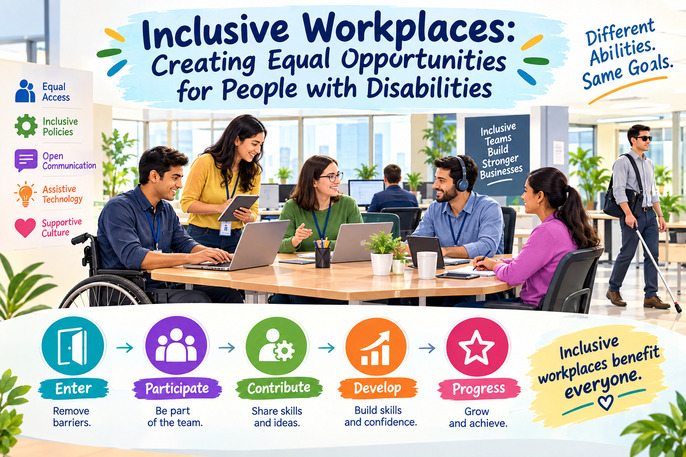
Creating an inclusive workplace means looking beyond simply hiring people with disabilities. It means creating an environment where employees can enter, participate, contribute, develop, and progress on an equal basis.
An inclusive workplace recognizes that people have different needs and abilities—and that removing unnecessary barriers benefits both employees and organizations.
What Is Workplace Inclusion?
Workplace inclusion means creating an environment where employees, including people with disabilities, have meaningful opportunities to participate and contribute.
It involves more than meeting minimum accessibility requirements. It can include:
- Inclusive recruitment practices
- Accessible workplaces and technology
- Reasonable accommodations
- Inclusive communication
- Equal access to training
- Career development opportunities
- Fair performance evaluation
- Supportive workplace cultures
- Leadership commitment to inclusion
The objective is to ensure that disability does not become an unnecessary barrier to employment or career growth.
Why Inclusive Workplaces Matter
Employment can provide financial independence, professional development, social connection, and opportunities to contribute to society.
For organizations, inclusion can also help create a broader talent pool. When recruitment and workplace systems are designed to reduce unnecessary barriers, organizations can access skills and perspectives that might otherwise be overlooked.
But workplace inclusion should not be viewed only through the lens of organizational benefits.
At its foundation, it is about creating fair opportunities for people to participate in working life.
Inclusive Hiring Starts Before the Interview
The journey toward workplace inclusion begins during recruitment.
Job descriptions can unintentionally discourage qualified candidates when they include unnecessary requirements or unclear language.
Employers can make recruitment more accessible by:
- Using clear and straightforward job descriptions
- Focusing on essential skills and responsibilities
- Providing accessible application platforms
- Offering alternative ways to communicate when appropriate
- Making interview locations accessible
- Providing reasonable accommodations during recruitment
- Training hiring teams on inclusive recruitment practices
A candidate’s disability should not automatically determine what they can contribute.
Recruitment should focus on the requirements of the role and the individual’s skills, experience, and potential.
Accessibility Goes Beyond Physical Spaces
When people hear “accessible workplace,” they may immediately think about ramps, elevators, accessible restrooms, or parking.
These are important, but workplace accessibility is much broader.
Modern workplaces also depend heavily on digital systems.
Employees may need to access:
- Websites and internal portals
- Email and messaging platforms
- Documents and presentations
- Video-conferencing software
- HR systems
- Training platforms
- Workplace applications
If these systems are not accessible, an employee may face barriers even in an otherwise physically accessible office.
Digital accessibility should therefore be part of workplace inclusion from the beginning.
Reasonable Accommodations Can Remove Barriers
A workplace accommodation is an adjustment that can help an employee perform their job effectively.
Depending on the individual and role, accommodations may include:
- Assistive technology
- Modified workstations
- Flexible working arrangements
- Adjusted schedules
- Accessible communication formats
- Additional time for certain tasks where appropriate
- Changes to workplace processes
- Remote or hybrid work arrangements where feasible
There is no universal accommodation that works for everyone.
The most effective approach is usually to understand the employee’s needs and identify practical solutions related to the job.
Inclusive Communication Matters
An inclusive workplace also considers how people communicate.
Meetings, presentations, training sessions, and everyday workplace conversations can unintentionally exclude people when accessibility is overlooked.
Simple practices can make a difference:
- Provide important information in accessible formats
- Use captions during virtual meetings where appropriate
- Share meeting materials in advance when useful
- Make presentations readable and accessible
- Allow different communication methods when appropriate
- Avoid assumptions about how someone should communicate
Good communication benefits the entire workforce, not only employees with disabilities.
Career Growth Should Be Part of Inclusion
Hiring people with disabilities is only the beginning.
An employee should have opportunities to develop skills, take on responsibilities, receive feedback, and progress professionally.
Organizations can support career growth through:
- Accessible professional-development programs
- Mentoring opportunities
- Leadership-development programs
- Transparent promotion criteria
- Skills training
- Accessible performance-management systems
- Opportunities to participate in important projects
If employees with disabilities are consistently hired into entry-level roles but rarely receive opportunities to advance, inclusion remains incomplete.
Creating an Inclusive Workplace Culture
Policies and accessibility features are important, but workplace culture can be equally influential.
Employees should feel comfortable discussing accessibility needs without fear of embarrassment or discrimination.
Organizations can encourage an inclusive culture by:
- Addressing disability-related stereotypes
- Training managers and employees
- Establishing clear anti-discrimination policies
- Encouraging respectful language
- Providing accessible internal communications
- Creating channels for employees to provide feedback
- Listening to employees with lived experience
Inclusion becomes stronger when it is part of everyday workplace behavior rather than an occasional initiative.
Managers Have an Important Role
Managers often have the most direct influence on an employee’s daily experience.
An inclusive manager does not need to know every answer. Instead, they should be willing to listen, communicate clearly, and work with employees to identify practical solutions.
Managers can:
- Ask employees what support would help them perform effectively
- Focus on outcomes rather than assumptions
- Provide clear expectations
- Give constructive feedback
- Ensure employees have access to development opportunities
- Address inappropriate behavior promptly
- Respect privacy around disability-related information
Most importantly, managers should avoid assuming what an employee can or cannot do based solely on disability.
Technology Can Support Inclusion
Technology is increasingly important in creating accessible workplaces.
Assistive technologies can include screen readers, speech recognition, magnification tools, alternative input devices, captioning systems, and other accessibility features.
AI is also creating new possibilities for accessibility, including tools that can assist with transcription, communication, information access, and content creation.
However, organizations should not assume that technology automatically solves accessibility challenges.
Technology needs to be accessible, reliable, appropriate for the individual’s needs, and compatible with the systems employees are expected to use.
Flexible Work Can Create New Opportunities
Remote and hybrid work have changed how many organizations think about workplace participation.
For some employees with disabilities, flexible working arrangements may reduce barriers associated with commuting, inaccessible environments, fatigue, or other workplace challenges.
For others, working remotely may introduce new barriers, particularly when digital platforms or communication tools are inaccessible.
The important lesson is that flexibility should be considered thoughtfully rather than treated as a universal solution.
Inclusion Benefits Everyone
Accessibility improvements often help employees beyond the people they were originally designed to support.
Captions can help people working in noisy environments. Flexible schedules can benefit employees managing different responsibilities. Clear communication can make information easier for everyone to understand. Accessible digital documents can improve usability across the workforce.
This is one reason inclusive design is so valuable.
When workplaces are designed with different needs in mind, more people can participate effectively.
Moving From Compliance to Inclusion
Organizations may have legal obligations relating to disability discrimination and accessibility. Meeting those requirements is important.
But inclusion can go beyond compliance.
Compliance asks:
“Have we met the required standard?”
Inclusion asks:
“Can people genuinely participate and grow here?”
That difference can influence how organizations approach recruitment, technology, workplace design, management, and career development.
Building the Workplace of the Future
The future workplace will likely be increasingly digital, flexible, and technology-driven.
That creates both opportunities and responsibilities.
Organizations can build inclusion into the future of work by considering accessibility when selecting technology, designing offices, developing policies, creating training programs, and building recruitment systems.
Most importantly, people with disabilities should be included in these conversations.
Employees who experience accessibility barriers firsthand can provide valuable insights into what works, what does not, and what needs to change.
Conclusion
An inclusive workplace is not simply a workplace where people with disabilities are hired.
It is a workplace where people have meaningful opportunities to apply their skills, access support, develop their careers, contribute ideas, and progress professionally.
Creating such workplaces requires action across the entire employee journey—from recruitment and onboarding to accommodations, technology, communication, leadership, and career development.
The goal is not to create identical experiences for every employee. It is to remove unnecessary barriers and create fair opportunities for people with different abilities.
When workplaces make inclusion part of everyday practice, they move closer to a professional environment where ability, talent, and potential—not unnecessary barriers—can shape a person’s career journey.