Introduction
What if the world were designed with everyone’s abilities in mind?
People have different ways of learning, communicating, moving, working, and interacting with their surroundings. Yet many environments and systems are still designed around a limited idea of what is considered “normal.”
Inclusive abilities encourage us to look beyond limitations and recognize the strengths, skills, experiences, and potential of every individual. Accessibility and inclusion help remove barriers so that people can participate more fully in education, employment, technology, and everyday life.
Creating an inclusive world is not simply about providing access. It is about creating opportunities, dignity, independence, and belonging.
What Are Inclusive Abilities?
Inclusive abilities are about recognizing and valuing the different abilities and ways people participate in society.
Rather than focusing only on disabilities or limitations, an inclusive approach asks:
What can we change or provide so that everyone has an opportunity to participate?
This could mean providing accessible technology, adapting learning methods, improving physical spaces, offering reasonable workplace accommodations, or communicating information in different formats.
The goal is not to make everyone the same. The goal is to create environments where differences are respected and supported.
What Is Accessibility and Inclusion?
Accessibility means making products, services, environments, information, and technology usable by people with different needs and abilities.
Inclusion goes a step further. It means ensuring that people are welcomed, respected, represented, and able to participate meaningfully.
For example, a building may have a ramp, making it physically accessible. But true inclusion also means that people using the building are treated with respect and have the same opportunities to participate.
Accessibility provides access.
Inclusion creates belonging.
Why Accessibility Matters
An inaccessible environment can create barriers even when a person has the skills and ability to participate.
Accessibility can include:
- Ramps, elevators, and accessible entrances
- Captions and transcripts
- Screen-reader-compatible websites
- Accessible digital documents
- Clear and understandable communication
- Assistive technologies
- Accessible transportation
- Flexible and appropriate workplace accommodations
When accessibility is considered from the beginning, fewer people are excluded by unnecessary barriers.
Inclusive Education: Creating Opportunities for Every Learner
Education is one of the most important areas for inclusion.
Students have different learning styles, communication needs, strengths, and challenges. Inclusive education aims to create learning environments where students can participate and develop their potential.
Schools and educators can support inclusion through:
- Accessible learning materials
- Flexible teaching approaches
- Assistive technology
- Accessible classrooms
- Individualized support where appropriate
- Inclusive extracurricular activities
- Awareness and respect among students
An inclusive learning environment can benefit the entire school community by encouraging empathy, collaboration, and diverse perspectives.
Building More Inclusive Workplaces
Employment is another important part of accessibility and inclusion.
Organizations can promote inclusion by making recruitment, communication, workplaces, and technology more accessible.
Examples include:
- Accessible job applications and interviews
- Reasonable workplace accommodations
- Accessible office spaces
- Assistive technology
- Flexible working arrangements where appropriate
- Inclusive workplace policies
- Training and awareness programs
Most importantly, organizations should focus on people’s skills, qualifications, and contributions rather than making assumptions based on disability or difference.
Technology and Assistive Tools
Technology can help reduce barriers and increase independence.
Tools such as screen readers, captions, speech-to-text software, magnification tools, alternative input devices, and other assistive technologies can support people in education, employment, communication, and everyday activities.
But technology must also be accessible.
A beautifully designed website is not truly inclusive if some users cannot navigate it. An online video is less accessible if important information is available only through audio. A digital document can become a barrier if it cannot be accessed using assistive technology.
Accessibility should be considered during the design process, not added only at the end.
Inclusive Design: Designing for Different Abilities
Inclusive design means considering a wide range of users when creating products, services, spaces, and experiences.
It can be applied to:
- Websites and mobile apps
- Public buildings
- Transportation
- Educational resources
- Consumer products
- Healthcare services
- Workplaces
- Entertainment
- Digital content
Designing with diverse users in mind can make experiences more usable and convenient for everyone.
Breaking Stereotypes About Disability
Accessibility is not only a technical or physical issue. Social attitudes can also create barriers.
Stereotypes and assumptions may lead people to underestimate what someone can accomplish or make decisions on their behalf without understanding their individual needs.
A more inclusive approach starts with listening rather than assuming.
People with disabilities and different abilities should have opportunities to express their preferences, make decisions, contribute ideas, and participate in conversations about the systems that affect them.
From Awareness to Action
Talking about inclusion is important, but meaningful change requires action.
Individuals and organizations can begin by asking:
- Can everyone access our information?
- Are our physical spaces accessible?
- Are our websites and digital services usable with assistive technology?
- Are our educational resources available in accessible formats?
- Are people with different abilities represented in our organization?
- Are we listening to people who experience accessibility barriers?
- What barriers can we remove today?
These questions can help turn awareness into practical improvements.
The Future of Accessibility and Inclusion
The future of inclusion depends on recognizing that diversity is a natural part of human society.
As technology, education, workplaces, and communities continue to evolve, accessibility should remain part of the conversation from the beginning.
Inclusive abilities encourage us to move away from asking, “Why can’t this person fit into the system?”
Instead, we can ask:
“How can we improve the system so more people can participate?”
That change in perspective can lead to better design, stronger communities, greater independence, and more opportunities.
Conclusion
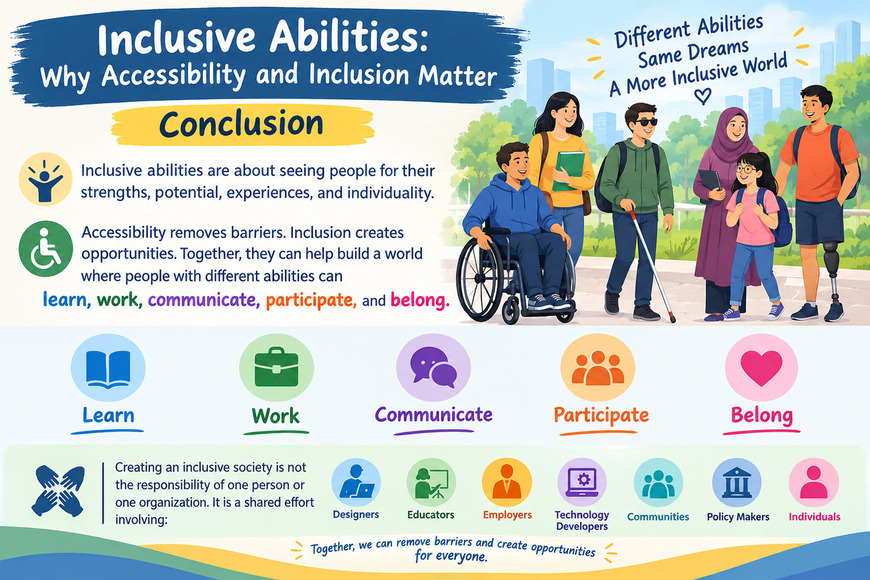
Inclusive abilities are about seeing people for their strengths, potential, experiences, and individuality.
Accessibility removes barriers. Inclusion creates opportunities. Together, they can help build a world where people with different abilities can learn, work, communicate, participate, and belong.
Creating an inclusive society is not the responsibility of one person or one organization. It is a shared effort involving designers, educators, employers, technology developers, communities, policymakers, and individuals.
A more accessible world is a more inclusive world—and inclusion begins when we design with everyone in mind.